
Product launches tend to break down in predictable ways: plans spread across tools, ownership gets fuzzy, and teams miss key steps until the last minute. Even with a solid product roadmap and a clear go-to-market strategy, turning intent into action can be difficult.
That’s where a product launch checklist comes in—it brings your launch strategy, roadmap, decisions, and documents together to avoid these common pitfalls. And when you have everything in one interactive, connected workspace, it’s far easier to stay aligned and move forward as product plans evolve.
Key takeaways:
A product launch is a coordinated effort to bring a new product or feature to market—and preparation is just as important as the product itself.
A strong product launch checklist covers four core phases: pre-launch planning, launch readiness, launch day, and post-launch evaluation.
Clear ownership across EPD, marketing, sales, and customer support teams is what separates launches that stall from those that ship on time.
Keeping your checklist, roadmap, and supporting docs in one connected workspace makes it far easier to stay aligned as plans evolve.
Free interactive templates from Notion can help you get started quickly—jump to the templates section to explore them.
What’s a product launch checklist?
A product launch checklist is a shared framework that helps teams plan, track, and coordinate every part of a product or feature release. It does so by bringing tasks, owners, timelines, and dependencies into one place so teams can see what’s ready, what’s blocked, and what still needs a decision before launch day.
But ultimately, your product launch checklist is more than just a to-do list—it also creates clarity across engineering, product, and design (EPD), marketing, sales, and customer support as work moves from pre-launch to post-launch. Having clear ownership and timelines in place also helps you tie tasks to the decisions that need to happen along the way.
Why do teams need a product launch checklist?
If a product launch fails, it’s rarely because teams aren’t working hard. While they may know what’s moving forward, they don’t always see what could slow things down.
More often, these factors are to blame:
Information is spread across tools.
Ownership isn’t clear.
Dependencies surface too late.
According to our research, while 58 percent of teams regularly share project or team updates, only 21 percent track dependencies or blockers across teams.* A product launch checklist closes that gap by making blockers visible early, tying them to owners, and keeping them alongside the work they affect.
But the issue extends beyond execution—ProductPlan’s 2025 State of Product Management report found that nearly half of product teams need to consolidate tools because fragmented systems create visibility gaps and silos. And Product-Led Alliance’s 2025 State of Product Operations report points to unclear roles and cross-team misalignment as additional drivers.
A product launch checklist addresses these challenges by creating a single source of truth for priorities, ownership, and coordination.
The difference between a launch that lands and one that falls flat often comes down to preparation and cross-functional alignment. Here's a quick comparison:
Signs of a successful product launch | Signs of an unsuccessful product launch |
All GTM teams—product, marketing, sales, and support—are briefed and aligned before launch day | Teams work in silos with unclear handoffs and last-minute updates |
Clear ownership is assigned across every function, with documented milestones and deadlines | No single owner for launch coordination; tasks fall through the cracks |
Sales is trained and equipped with messaging, demos, and objection-handling materials ahead of launch | Sales learns about the launch the same day customers do |
Support documentation is live before the product ships, with escalation paths in place | Support improvises answers for days or weeks after launch |
Post-launch performance is measured against defined KPIs, with a retrospective scheduled | No structured review; lessons aren't captured and the same mistakes repeat |
What should your product launch checklist include?
A strong product launch checklist focuses on the decisions and work that matter most at each stage of the launch process rather than trying to capture everything at once. In this way, it makes important information easy to revisit as plans change.
Ultimately, your goal when creating a product launch checklist should be to help your product teams align on what success looks like and keep progress visible. This gives stakeholders a clear, shared view of what’s moving forward and what decisions are coming up next.
Ready to make your own? Here are some of the key components of a typical product launch checklist to help you get started:
Clear goals, launch scope, and success criteria
Every new product launch starts with intent—but a product launch checklist turns that intent into something actionable by clearly defining these aspects:
What you’re launching
Who the target audience is
How you’ll measure success
To do this, you’ll want to set clear goals, define success metrics, and identify the KPIs that connect to adoption, conversions, or user engagement. When this context is clear from the start, product managers can make quicker decisions as new product development features or trade-offs come up.
One of the most useful frameworks for scoping a launch is defining its tier. Not every release warrants the same level of investment, and matching your effort to the significance of the launch prevents both under-preparation and unnecessary overhead.
Tier 1 (Major): A new product or strategic repositioning. Requires full cross-functional coordination, a press release, and a significant marketing campaign. Think new product lines, major platform launches, or pivotal positioning changes.
Tier 2 (Moderate): A significant new feature or meaningful improvement. Requires a marketing announcement, sales enablement materials, and updated support documentation.
Tier 3 (Minor): A small enhancement or bug fix. Requires release notes and internal support awareness, with minimal marketing activity.
Determining the tier early shapes everything that follows—how much lead time each team needs, which checklist items apply, and how to allocate resources across the release.
Ownership across EPD and go-to-market teams
A successful product launch depends on clear ownership. After all, if no one’s sure who owns the next step, a launch can easily stall.
That’s why a good product launch template helps you assign clear ownership across your EPD team, as well as marketing, sales, and customer support. When responsibilities are visible, everyone knows what they own and where gaps or blockers might exist.
Notion AI can also help you spot these blind spo. For instance, you can have it scan your checklist to spot tasks without owners or get a quick summary of what still needs attention before the next handoff.
Technical requirements, QA steps, and release blockers
Before a product release is really ready, you need to test every feature and workflow. That’s why a complete product launch checklist defines and tracks quality assurance (QA) steps, beta testing, known risks, and unresolved blockers that could delay launch day.
Keeping this information alongside launch tasks also helps you flag issues early and avoid last-minute surprises that affect user experience or stability.
Launch timing, milestones, and approvals
Timing matters in every launch phase, which is why a product launch plan that reflects key milestones, review points, and approvals can help you stay on track. When you specify timing in a shared product launch checklist, all your teams can see changes as they happen and stay aligned when plans shift.
Go-to-market materials and support workflows
A strong go-to-market strategy relies on preparation. To help with this, a product launch checklist ensures that your teams have all the materials they need by linking to this information:
Product marketing assets
Messaging
Pricing
Onboarding flows
FAQs
Enablement materials
When you have all these pieces in one place, your sales and support teams will be ready to confidently engage customers as soon as the product launches.
With a shared product launch database like Notion, you can connect these assets directly to launch tasks so your teams always know where to find the right information when they need it. But what makes it even more powerful is Notion AI, which can pull together the right context, summarize what matters, and surface key details on the spot so reps can respond to customers without reading every launch doc end to end.
For Ramp in particular, using Notion AI to link launch planning and sales enablement has allowed its sales team to speed up all kinds of tasks, from customer call summaries to campaign analysis.
Post-launch evaluation and learnings
The work doesn’t end at launch—the lessons you learn along the way are how you improve your next launch. And when you keep the full launch story in one place, it’s easier to see where you can do better.
With one of Notion’s launch checklist templates, you can capture this feedback all in one place:
Post-launch reviews
User feedback
Performance analysis
Documented learnings
How to use a product launch checklist during your release cycle
A product launch checklist works best when it stays close to the work, not tucked away as a planning artifact. After all, you’ll need to return to it throughout the release cycle—from pre-launch to launch day and follow-up—to coordinate decisions and maintain clarity. Here’s how you can do that:
Track progress and surface blockers early
Early in the release cycle, your checklist helps you see how work is progressing. For instance, as teams update task status and flag risks, you can quickly spot where timelines might slip or where dependencies need attention before they become problems. But this becomes more difficult to do if the information is scattered.
Centralizing your launch checklist instead eliminates the need to chase updates across tools and allows you to see what’s ready and what isn’t. Notion AI can also provide support here by summarizing progress across tasks or highlighting areas that need input before the next milestone.
This is how Vercel uses Notion to launch products. By keeping its launch information in a shared workspace, it’s able to give its teams a clear view of what’s shipping, who owns each release, and which issues need attention before they escalate.
Holding a go/no-go meeting
One of the most important—and frequently skipped—checkpoints in any launch cycle is a formal go/no-go meeting. Schedule this one week before the target launch date, with all functional leads in attendance. In this meeting, review the readiness of every item on the checklist and make an explicit, documented decision to either proceed with the launch, delay it, or reduce its scope. Having this decision made in advance—with clear criteria for what constitutes a launch blocker—prevents the ambiguity and last-minute scrambling that derails otherwise well-prepared launches.
Keep stakeholders aligned with quick updates
As launch day approaches, clear communication matters just as much as execution. That’s why it’s important to have a checklist—it gives you a consistent place to capture decisions, approvals, and changes so stakeholders don’t have to piece together updates from meetings and messages. Then, when someone asks where things stand, you can point to a single source of truth or share a quick summary instead of rewriting the same update.
Notion AI also helps here by generating short updates directly from the checklist so everyone can stay in the loop without adding more meetings or manual reporting.
Make checklists repeatable for future launches
After launch, the checklist becomes a record of what happened, which makes it easier to turn one-off launches into repeatable workflows. With it, you can see this feedback:
Which steps slowed things down
Where ownership worked well
What needs adjusting next time
At Partiful, teams use Notion to connect projects to shared docs and wikis. This gives everyone clarity and alignment across launches so it’s simpler to reuse what works and improve with each release.
Why interactive checklists work better than static spreadsheets
If you search for a product launch checklist template, you’ll find plenty of spreadsheets that you could use. But while a spreadsheet format might be familiar and easy to use, it often falls apart once launches get complex as updates go stale, versions drift, and important context scatters across disconnected docs, threads, or meetings. That means you’ll end up doing extra work just to keep everything aligned.
But interactive checklists in Notion work differently. With them, you can tag teammates, assign owners and due dates, and connect launch tasks directly to roadmaps, docs, and supporting assets.
Notion’s database views also let each team see the work in a way that makes sense for them without duplicating information. And because everything updates in real time, cross-functional teams can easily stay aligned as plans change.
When you have all that context in one place, Notion AI can also speed up the menial tasks by helping you surface what matters most, summarize progress, flag gaps, or pull answers from across launch docs. That way, you can move faster without digging through endless files.
Product launch checklist templates
Below are some launch templates you can adapt to your process—whether you work in Agile sprints, a Kanban flow, or a hybrid cadence. Each of these three balances structure with flexibility so you can make it your own and keep work connected to decisions, context, and outcomes:
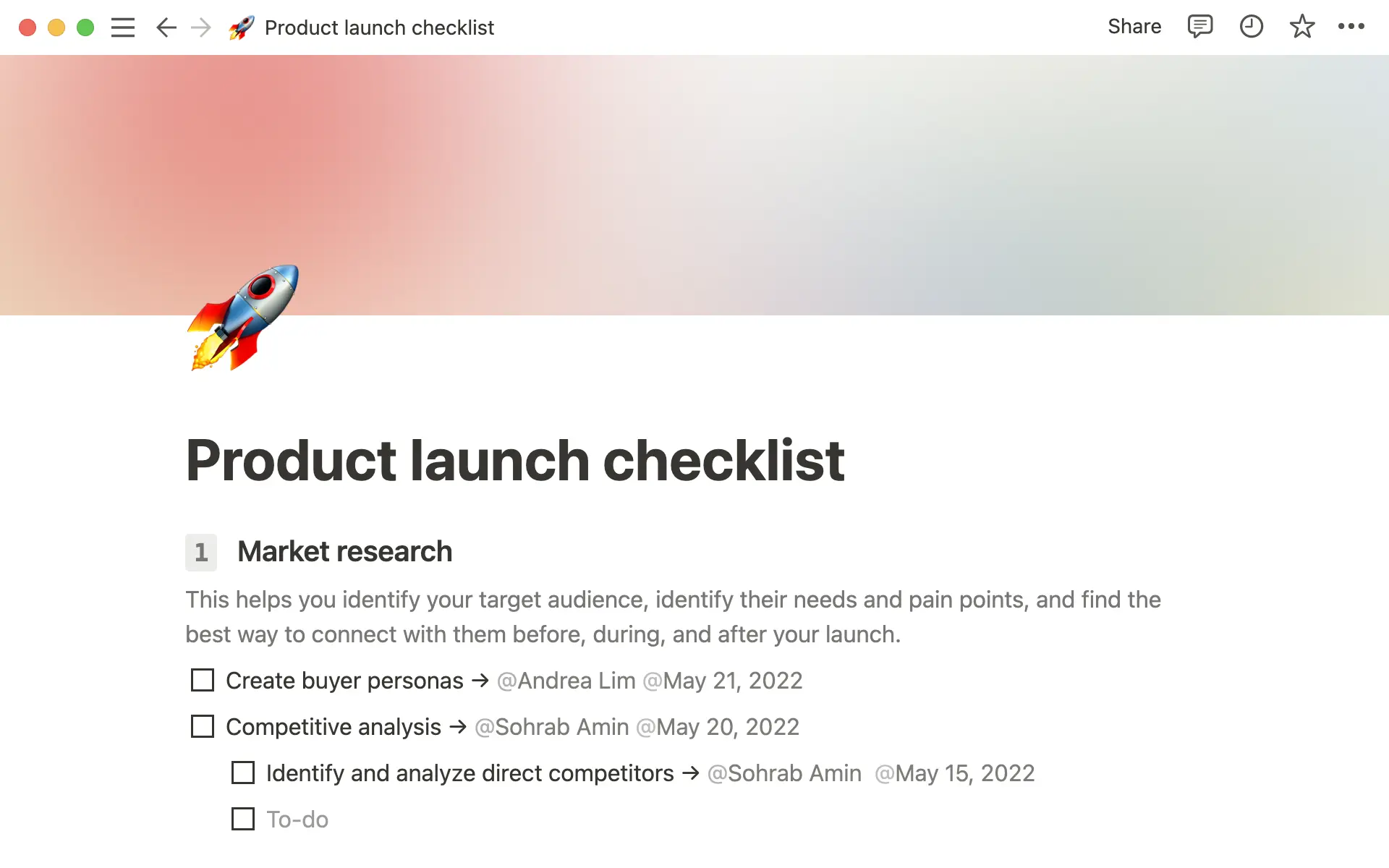
Product launch checklist
Notion’s product launch checklist template provides a comprehensive starting point for managing core launch work. It breaks launch activities into milestones and tasks, with built-in owners, due dates, and status. You can also tailor fields to your team’s workflow by adding custom tags for sprint cycles, priority levels, or risk status.
Additionally, you can link related docs like user research, specs, and stakeholder feedback directly to your launch tasks so context stays with the work.
For example, at OpenAI, teams use Notion to capture and organize shared knowledge and processes so everyone can act on the same context as work evolves. This accelerates collaboration and decision-making across its EPD and research teams.
Product launch plan
Our product launch plan template offers an alternative format that gives you a clear view of your entire launch, from early planning through release and follow-up.
With its built-in sections for goals, milestones, owners, and launch tasks, this template makes it easy to see how work connects across teams. You can also customize it to your process by adding sprint markers, Kanban stages, or custom fields for risk, readiness, or approvals.
Product launch event planning checklist
For launches that involve either external or internal events, Notion’s product launch event planning checklist template centralizes all your event organization tasks, including these:
Logistics
Invites
Speakers
Tech needs
Follow-ups
Connecting this event plan to your core launch checklist ensures that announcements, demos, and post-event feedback loop into your overall launch process.
Plan your next launch with Notion AI
A successful launch depends on clarity, so having a product launch checklist in place keeps every step connected to your product roadmap, launch plan, and go-to-market strategy. After all, when everything is visible in one unified workspace like Notion, it’s easier to optimize how your teams work together as product plans evolve.
Ready to launch with confidence? Explore how Notion supports product planning and helps teams move from idea to release today.
*Notion Internal Survey (N = 624). Respondents were Notion users in collaborative work environments across the US, UK, France, Japan, South Korea, Brazil, Australia, India, and Canada.
